Sunday, July 6, 2014

Roches Blanches (No 52) and Crêt de la Neige (No 51)


 Checking-out Roches Blanches (at left) and Crêt de la Neige (right) from the summit of Mont de la Maya in October 2012.

It's been a long time between summits this year, but we finally got around to hiking to the top of a couple of new Jura peaks this weekend - Roches Blanches (No. 52) and Crêt de la Neige (No 51).
Both peaks are located on the second ridgeline behind Le Chasseron, near Ste-Croix - which is about 75 minutes drive north of our home in St George. We headed-up there via Lausanne and Ste-Croix on Saturday, 5 July 2014, and parked the car at the base of the ski lift in Buttes (770m). The drive up and over the main (eastern) Jura ridgeline was as lovely as ever, and it got even better once we'd passed through Ste-Croix and entered the Vallon de Noirvaux and some beautiful precipitous gorge country at the headwaters of Le Butte river. We slowed-down to enjoy the views, and to watch a couple of chamoix that sauntered along near the side of the road at one point.

Buttes is a very picturesque, old village in the District of Val-de-Travers, in the Canton of Neuchâtel. The word "Buttes" comes from the French word "butte" meaning "a small elevation". The first records of the village had it down as "Boutes" (1342), which, if derived from "bout", referred to its location on "the extremity of a territory" - perhaps alluding to it being so close to the Swiss-French border, as well as the border between the cantons of Vaud and Neuchâtel.

 The village of Buttes basking in the sun 
below the Montagne de Buttes ridgeline.

We parked right alongside the "Auberge des Fées" (Hotel of the fairies), and shouldered our packs before heading-up the Jura ridgeline that loomed-up on the southern side of the valley.


We stayed around for a few minutes to check-out the impressive-looking information board, which showed all of the winter ski-lifts and pistes, as well as the summer hiking routes, and mountain-biking and VTT "mountain-scooter" trails. We hadn't been completely sure of what route we'd take up the mountain until now, but, after checking-out the map, decided to follow the well-marked "green" trail that led all the way to Le Chasseron (1607m, No. 14 on the list of highest named peaks in the Jura).

Information board in Buttes. The cutting through the forest in the ridgeline above marks the location of the ski-lift to La Robella. It runs all-year-round.


At around 10:30am,  in beautiful sunshine, we headed-up the road south of town, found the start of the off-road trail (just west of the La Plata homestead), and began zig-zagging our way up the mountainside.

Heading out of Buttes.

The trail wound its way through a beautiful tall mixed forest (mainly beech and fir) called the Bois de Ban. Mostly it was easy going, with thick, spongy masses of soft, cushioning leaf-litter underfoot. In some places, especially as we skirted around the western side of Crêt Rond (989m), it got quite steep and rocky, but still a gorgeous trail.

A section of the trail through the Bois de Ban.

From time to time, the trail intersected with the VTT "mountain scooter" trail - a specially made course for kamikaze trail riders who like the idea of charging down the mountainside on one of those fat-wheeled scooters. There were jumps and all sorts of obstacles and features built into the course (as well as lots of netting and giant cushions strapped to trees to keep life and limb together).

Sign post warning trekkers about possibly meeting downhill-racing mountain elves (on scooters) at Plan des Auges (1040m).

For a few sections of the trail above Plan des Augues (1040m), the pedestrian and mountain-bike trails ran side-by-side, or sometimes even shared the same stretch of forest track. It paid to keep your eyes open, and wits about you. However, although the ski-lift at Buttes was operating - to take scooter dare-devils to the top of the run - at La Robella - we didn't meet anyone else on the trail. We had the entire mountain-side to ourselves, and that was an absolute treat. It was glorious. Appropriately, for such an enchanted forest, we came across a "Fontaine des Fées" (fairies' fountain), from which we took a drink, but at which we saw no fairies. However, the forest and trail was just gorgeous, so it wouldn't have surprised us if there were lots of fairies and elves in there.

Lis getting a drink from the Fontaine des Fées.

We finally emerged out of the forest, just after the trail had rejoined the road between Buttes and La Robella ... which in fact continued up and over the mountain - to Bullet on the southeast side of the ridgeline. Coinciding with us leaving the Bois de Ban it began to drizzle with light rain, so we sheltered for awhile under a tree and ate a snack bar. Once it became obvious that the rain wasn't going to let-up, we headed back out onto the trail and continued our journey.

Before long we approached La Robella (marked Petite Robella on the topo map) - which is both a farmhouse and a restaurant, and the staging-post for the top of the Buttes ski-lift. Despite the (now) gloomy weather and grey skies, La Robella was a burst of bright colour - thanks to hundreds of all-shades-of-red geraniums that were growing in pot-plant boxes that adorned the building.

Passing by La Robella farmhouse-restaurant.

We stopped just long enough to admire the hanging gardens, and to take a few photos, and to check-out an information panel about the famous writer, philosopher, musician and botanist Jean-Jacques Rousseau - who visited La Robella in 1765. (I previously wrote a bit more about Rousseau in the blog that I posted after climbing Le Chasseron in October 2012. You can read it here if you're interested.)


Upon leaving La Robella we decided to leave the marked trail and instead headed straight up the hillside due south of the homestead. This proved to be a (very steep) short-cut, and, in about half-a-kilometre we rejoined the walking trail - which ran alongside an old dry-stone wall that ran up and along the ridgeline. The wall also marks the boundary between the cantons of Vaud and Neuchâtel.

Heading up the steep slope just south of La Robella. The famous Swiss watch-making town of Fleurier lies far in the distance in the valley below.

We followed the trail along the spur until it reached a gap in the wall - at the point on the topographic map marked 1438.2 (there are a couple of small huts there) - at which point we crossed over the ridgeline and headed down into the small valley immediately to the south. There we came across a trail sign-post marking "Crêt de la Neige 1425".

Signpost at "Cret de la Neige 1425".

It obviously wasn't the crêt (being in a valley floor), but we could see the real crêt rising-up before us - just a little further to the south. We headed off more-or-less along the hard-to-distinguish trail towards Le Chasseron, which became a bit more apparent once we reached the ridgeline - at which point we turned southwest (off the trail) and made our way up the spur. About 300 metres further up the ridge we reached the highest point of Crêt de la Neige - 1472 metres - our first summit and destination for the day. It was now about 12.30pm (about two hours from when we'd left Buttes).

Lis at the top of Crêt de la Neige.

There was nothing of any note to distinguish the summit, and no signs of anyone ever having been up there. It's obviously an "off the beaten track" Jura summit, and probably relatively little known and climbed. I'm not sure why it's called Crêt de la Neige, but guess it's much the same as the other Crêt de la Neige - the highest peak in the Jura (1720m), way down south in the French Jura, overlooking Geneva: That is, because snow hangs around on the sheltered slopes long after it has disappeared from all of the neighbouring peaks and surrounding landscapes in spring. Needless to say, there was no snow anywhere in sight today. Just some scudding clouds and drizzling rain. So we stayed just long enough to take a celebratory photograph, and peer through the clouds to catch glimpses of Le Chasseron, then we searched around for a dry spot under a tree to have our lunch.

Atop Crêt de la Neige (1472 metres).

Le Chasseron (1607m) and Petites Roches (1583)m) from Crêt de la Neige.

After lunch (which we enjoyed out of the rain - under the shelter of a huge old fir tree), we shouldered our packs (at about 1pm) and retraced our steps back down the ridgeline, and into the swale where the 1425m signpost stood. We stopped there just long enough to get our bearings for our next destination - the summit of Roches Blanches - which we could see about one and half kilometres off to our southwest. Down the valley, not only could we see Roches Blanches, but also the peaks of about six other Jura peaks that we've climbed on previous Jura Mountain rambles: Le Chasseron, Petites Roches, Aiguilles de Baulmes, Dent de Vaulion, Mont de la Maya and Mont d'Or.

Looking southwest from Crêt de la Neige, with Le Chasseron, Petites Roches, Aiguilles de Baulmes, Dent de Vaulion, Mont de la Maya, Mont d'Or and Roches Blanches on the horizon.

Mont de la Maya and Roches Blanches from the Crêt de la Neige signpost at 1425m.

We headed back up to the canton boundary ridgeline (that we'd passed over an hour or so before), and picked-up a small trail that headed uphill - southwest along the top of the ridge. We soon came across an old stone marker - dated 1719 - with the emblems of Vaud on one side and Neuchâtel on the other. In all we saw about three or four of these along the trail.

Lis at one of the old stone canton boundary markers, with the Crêt de la Neige ridgeline in the background.

We stopped at the first of these and took some photos, and soaked-up the beautiful views down the valley towards Le Chasseron and the other diminishing peaks of the southern Jura.

The view towards Le Chasseron - with the Chalet des Roches Eboulées (middle-ground at left) and La Deneraix Dessus (right) farmhouses in the valley of La Dénériaz below.

Mont de la Maya and the cliffs of Roches Blanches.

The trail wound its way through a beautiful forest - with steep cliffs and drop-offs on both sides. Despite the weather, and the dense forest, from time to time we got some great views of the surrounding peaks. The trail was pure wilderness, with plenty of obstacles in the form of fallen logs and rocky ridges to negotiate. We came across a trail sign advising us that we were now in the Roches Blanches nature reserve, with a suite of conditions to help protect the place.

The Roches Blanches nature reserve sign.

Although less than two kilometres in distance, this ridgetop walk still took some time - partly because it was uneven ground, and partly because it was such a beautiful place to be hiking, which meant we stopped a lot, to take lots of photos.

An old 1719 canton border stone.

Moss-covered rocks near the top of Roches Blanches.

Mid-summer meant there were lots of beautiful flowers along the trail.

Eventually we arrived at the highest point of Roches Blanches - 1470 metres - which was marked by another, more substantial, canton boundary marker stone. We dropped our backpacks, and pulled out a hip-flask of marc for a celebratory drink. It was now about 2pm.

The highest point of Roches Blanches - 1470m.

As always, and has become our custom for these rambles, we took a few celebratory, commemorative photos flying the Swiss flag, and then wandered around for awhile to soak-up the atmosphere and enjoy the views.

Enjoying a nip of marc at Roches Blanches.

Flying the flag at Roches Blanches - number 52 on the list of highest named Jura peaks.

Checking-out the views from Roches Blanches towards the southeast.

The cliffs and summit of Le Chasseron across the valley.

Roches Blanches is a popular destination for rock climbers ... but we didn't encounter anyone at all today. All we heard were the sounds of songbirds. And the only other beings we came across were huge snails and slugs. No chamois, no lynx, in fact nothing much of any note except some beautiful butterflies.


 That's where we were - atop the cliffs of Roches Blanches 
(taken from Petites Roches in October 2012).

After about half an hour, we re-hoisted our backpacks, and headed back down the trail - retracing the same route that we'd followed on the way up. It wound its way along the ridgetop, and through the leafy green forest back towards La Robella.

Heading back down through the forest.

Snowshoe trail sign on a tree near Roches Blanches 
pointing towards Crêt de la Neige.

We stopped from time to time to admire the views, and to take a few more photos. It really is a beautiful part of the Jura and well worth the trek up here.

One last look down the valley to the southwest 
before leaving the Roches Blanches ridgetop.

With the weather improving, and bursts of sunlight even brightening up the day, we headed back down the mountain towards La Robella and Buttes. It was an easy walk, through the same beautiful forests and flower-filled alpine pastures, and we soon dropped back down the 700 metres of altitude that we'd gained on the way up earlier in the day.


Wildflowers near the trail at Brama-Fam near La Robella.

The return trip was just as enjoyable as it had been on the way up, and we were soon back in the car-park at Buttes - arriving there at about 4pm - five and a half hours after we'd set-out this morning. The two peaks bagged today were our 57th and 58th of the Jura's highest peaks - leaving just 10 peaks unclimbed on our Jura Mountain Rambling list. Stay tuned.

Jura Peaks bagged:
  • Crêt de la Neige (No 51) 1472m
  • Roches Blanches (No 52) 1470m


Thursday, March 13, 2014

La Cornette (No 47) & L'Egasse (No 56)


La Cornette and L'Egasse are two relatively little known peaks in the Jura Mountains, frequently bypassed by hikers looking to climb their higher, more prominent and more popular neighbour - Chasseral (ranked number 13 in the Jura - at 1607 metres). Despite being overshadowed by Chasseral, they're still legitimately on the list of the highest named Jura peaks - at number 47 and 56 respectively, so were there to be climbed one sunny day. And a sunny day it was on Sunday 9 March, 2014, when we set out to "bag" these two peaks.

Quite surprisingly, this is the first Jura summit hike that we've logged for 2014, mainly because we've been hiking elsewhere these past three months, have been traveling further afield, or have been restricted by the many weekends of less-than-favourable weather that typified the winter of 2013-14. If I'm going out to bag a Jura Mountain peak these days, the weather has got to be as ideal as possible. (Enough of the grey weather photos, I say).

And such was the case (i.e., sunny weather) last Sunday, when we drove about an hour and a half north of our home in St George, past Neuchâtel and Lac Neuchâtel, and back up into the Jura foothills to a small village called Nods (885m) from where we intended to start our hike. We drove straight through the town and found the road that headed-up to the Col du Chasseral, but stopped just on the outskirts of the village - in a car-park - from where we commenced our hike. We left the car-park at about 10:30am and, in glorious sunshine, began making our way up the forested slopes just north of the village.

Trail interpretation panel on outskirts of Nods.

With our snowshoes strapped to our backpacks, we "skipped" our way along the paved road that leads towards the Col - which is about five or six kilometres further up the mountain. But after just 500 metres along the road we came across a boom-gate that blocked further vehicular access - a regular winter seasonal closure due to the heavy mantle of snow that blanketed the upper slopes of the range at that time of the year.

The barrier gate on the road to the Col du Chasseral.

We negotiated our way around the gate, and then continued along the road atop the well-trampled-down snow. We were still in just our hiking boots. About a further 500 metres along the road, we crossed-over the main ski piste that comes down the mountainside from Hotel Chasseral to Nods, and soon after that turned right - onto a well-marked snowshoe trail (that followed the same route as the main summer walking trail up the mountain). It was a great trail, which led us through a beautiful patch of (predominantly spruce) forest. As one would expect, we were in high spirits as we began gaining altitude up towards the top of the main Jura ridgeline. We had about 600 metres of vertical altitude to gain to reach the crest, and about three kilometres of horizontal trail.

On the gorgeous snowshoe trail through the forest.

Sunlight filtering through the forest near Le Brulé.

For the most part, it was a relatively easy, gentle gradient, and well packed-down by previous walkers and snow-shoers. But after about a kilometre, we began to sink deeper into the snow and each step became progressively more difficult, so we stopped and pulled-on our snow shoes, after which we continued with much greater ease and assurance.

Heading-up through the forest near Les Cordonniers.

The snow shoes really became beneficial once we emerged from the forest again - at the upper tree line (at about 1400 metres) - where the snow was fresher, and deeper, and the gradient quite steep. Off to our right we got our first glimpses of the huge (120 metre high), red-and-white striped, communications tower that stands at the top of Chasseral (or Gestler - as the mountain used to be called under its German name) - which is the highest peak in the Bernese Jura. We'd first summited Chasseral back in September 2012 and, if you're interested, you can read the account of that hike here. Ahead of us, on the horizon, we could see our first destination for today - the semi-snow-covered Hotel Chasseral. I have a fondness for Chasseral for a number of reasons, one of which is that it was the setting for Hermann Hesse's famous 1907 short story "The Wolf". It's a sad tale, but well worth reading.

 Lis standing above a half-buried trail marker just below Chasseral.

 The distinctive "barber's pole" communications tower atop Chasseral. 
It was erected in 2010, on a site that has had a telecommunications station 
since June 1945.

The only landmark across the open ground (the "Paturage de Chasseral) below the Chasseral ridgeline was the half-buried (and completely closed) Métairie Neuf Chalet - which is marked Mét. de Nods on the topographic map. (A métairie is an alpine farmhouse / tavern, where the owners provide seasonal meals to travelers - including home-made cheese - usually served in a traditional fondue.)

Sign outside the Métairie Neuf Chalet (or Nods?).

We stopped just long enough to take a photo, then pushed-on up the last stage of the ascent to the Hotel Chasseral. Once this landscape thaws-out (in spring), it's possible to drive (or catch a bus) all the way up to the hotel, so it's a popular day-trip destination throughout the summer months. But now, with a healthy blanket of snow over the whole mountain-top, the only visitors are those who are prepared to walk, snowshoe or ski all the way to the top of the ridge.

Heading-up the last ascent towards the Hotel Chasseral.

We got there at about mid-day, about an hour-and-a-half after we'd left Nods, and immediately flopped-down on one of the huge rocks that lined the southern edge of the ridge. At 1548 metres, it marked an altitude gain of about 600 metres from where we'd left the car in Nods. It looked like an ideal spot to enjoy our lunch, so we dropped our packs, took out our food, and munched away while we gazed-out over the plateau towards the distant, hazy Alps.

Lunch-stop on the rocks near Hotel Chasseral. It was first built in 1880, although rebuilt in 1925 when the original was destroyed by fire.

Although blessed with beautiful sunny, and intensely blue, skies above us, the views back down the mountainside and across the plateau to the Alps was somewhat less-than-perfect - being mostly obscured by a cloudy haze that filled the wide chasm between the two mountain chains. Through the haze, we could only just see the near side of the Lac de Biene below us, and we couldn't make-out the city of Biel/Bienne at the northeastern end of the lake at all. Similarly, we couldn't see much of the Alps - other than a thin profile of just the tops of the very highest peaks. No matter, the views around us - of the Jura - were magnificent. We had a great 360 degree panorama - that included Chasseral (to the northeast) and Chasseral Ouest (to the southwest). As mentioned previously, we'd been up this way back in 2012 - when we "ticked-off" five peaks - Chasseral, Petit Chasseral, Chasseral Ouest, Les Roches and La Corne - all in a single day's hike.

Trail signage at Hotel Chasseral.

After lunch (standard trail fare of cheese and home-made chutney sandwiches, hot tea, and fruit ... we had to ignore the alluring smells emanating from the Hotel's kitchen and dining room), we wandered around the ridge to check-out the signage, the views, and our next destination way-point.

We are there (at the red dot) - Hotel Chasseral.

Off to our northeast was the summit of Chasseral (1607m) and, to the north, Petit Chasseral (1571m) and the main Jura ridgeline.

Checking-out the views from the top of the Chasseral ridgeline.

To the southwest, the ridge was dominated by Chasseral Ouest (1552m) and further afield, the peaks of the southern Jura.

Looking southwest with Chasseral Ouest at left, and our trail down in the foreground.

To the north, less than a kilometre away, lay the second Jura ridgeline, on which were the two peaks that we were intending to climb today - La Cornette and L'Egasse. Just to their right (to the east) was the valley and gorge of Combe Grède - which we fondly remember as being the scene of one of best walks we'd ever had in the Jura (en route to the top of Chasseral in September 2012).

Looking northwest - with our destination peaks - La Cornette and L'Egasse 
across the valley above the half-buried Métairie de St-Jean.

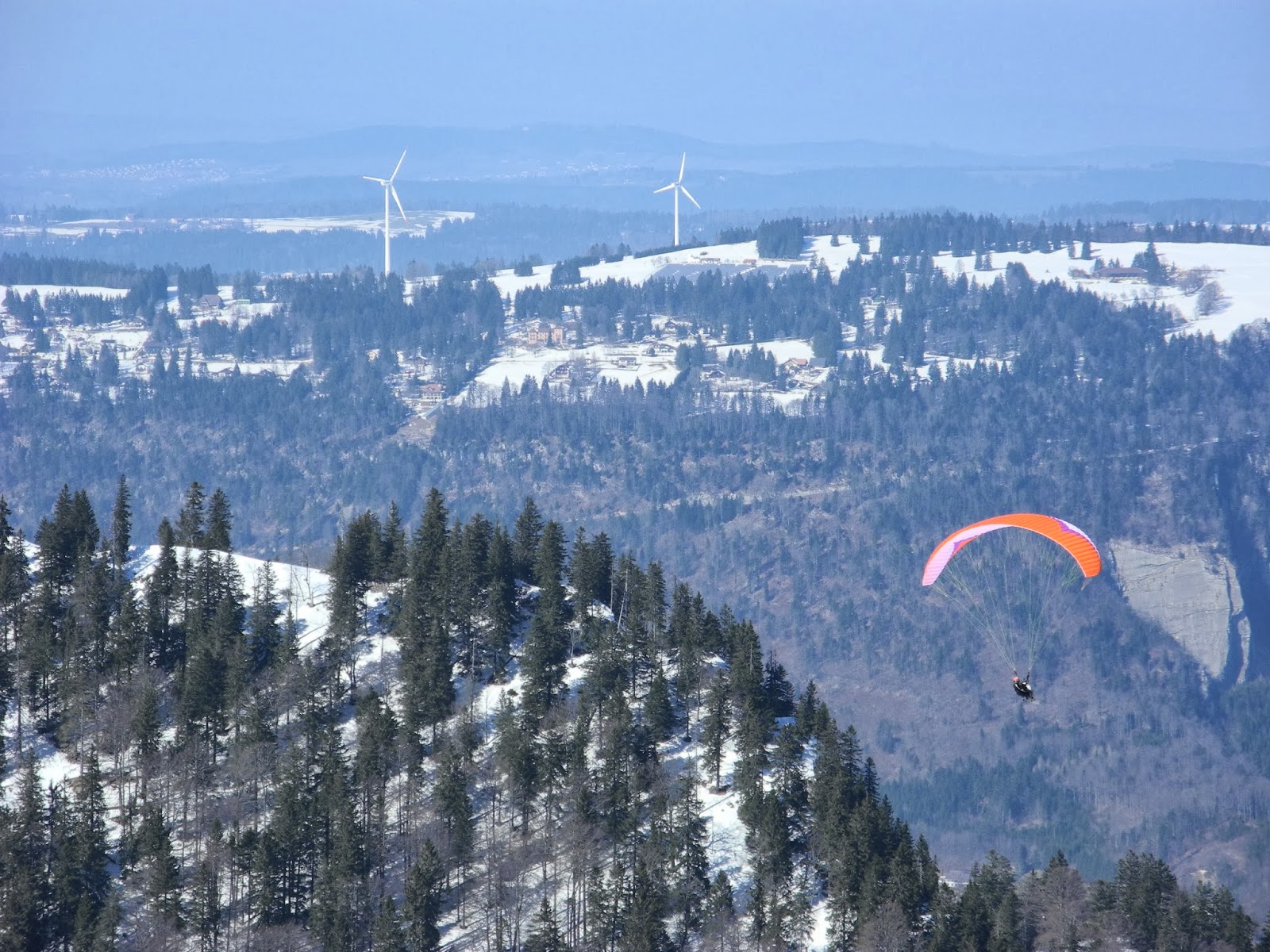
We stood there for quite awhile - watching paragliders fill their kites and leap-off the mountain-top before gliding their way over the range and down through the Combe Grède gorge towards St-Imier on the far side of the main ridgeline.

A paraglider passes L'Egasse on their way down through the Combe Grède.

Sometime around 1pm, we left the ridge-top in the vicinity of the hotel and headed down the steep slope on the northern side of the ridge - clinging precariously to the thin trail that snowshoers and skiers had carved into the heavily compacted snow. At times it was quite icy, and thus very slippery, so required a bit more attention than what we'd had to apply thus far on our walk. Of course, that also made it all the more exciting.

Heading down the north slope below Chasseral Ouest.

Once down in the valley floor (the lowest point of which is about 1389m), we cut a new trail due west across the snow, passing by the (winter-abandoned) Métairie de St-Jean and some signage reminding us that we were now deep in the Réserve Naturelle de la Combe Boisse (established in December 1976).

Trail sign reminding us that we were in the Réserve Naturelle de la Combe Boisse.

From there we headed up the next ridgeline - on a route that more or less followed the border-line between the Canton of Biel/Bienne (to the north) and Canton of Neuchâtel (to the south). Occasionally we were passed by skiers - mostly hardy-looking athletes geared-up for hard-core back-country adventuring. We were tortoises by comparison to their downhill plummets, but kept a similar pace going uphill.

Heading-up the slope towards the La Cornette ridgeline.

Once at the top of the ridge, in a small col, we stopped just long enough to catch our breath, and take a few photos of lichen-encrusted, weather-beaten reserve signs, then turned northeast along the ridge - towards the summit of La Cornette.

Ancient sign in the Reserve de la Combe Boisse. Hunting prohibited.

Looking northeast up the ridgeline of La Cornette.

Along the way we passed another protected area marker - this time for the Combe Grède Nature Reserve (1,202 hectares, established in May, 1932). This bright, new, blue sign stood atop a couple of very old, weather-beaten stone markers whose purpose I wasn't exactly sure. However they looked like they were marking a boundary of some sort, perhaps between the St Imier (or Villeret) and Nods communes, or something like that.

Reserve sign atop old stone markers - perhaps the border between
 the cantons of Bern (ahead) and Neuchatel (behind), or the communes of St Imier (or Villeret) and Nods.

It didn't take us long to reach the very top of the ridge - the summit of La Cornette (1494 metres) - which is actually a twin-peak mountain-top, with a mountain refuge hut nestled between them.

The mountain refuge at La Cornette.

Cornette means "rocky point, or peak", and comes from the Latin word cornua - which means a horn, or summit, or high point of land. La Cornette is in the commune of Villeret, in the district of Courtelary, canton of Bern/Bielle.

Sign above the door of the La Cornette hut: 1492m.

We dropped our backpacks and wandered around for awhile, before snapping-off the customary, ceremonial, flag-waving shot, and savouring the views from yet another Jura peak. It provided excellent views back over towards Chasseral and other smaller peaks of the main ridgeline.

Customary ceremonial flag waving shot at the summit of La Cornette.

Just to be sure, we took photos on both of the peaks, then took a swig of water and munched our way through a tasty fruit-and-nut bar.

More flag waving at the second La Cornette peak.

Our next destination - the top of L'Egasse - was only a few hundred metres away to the north. But first we had to drop down off La Cornette, cut across a small, barren col, and then follow the ridgeline further northeast to the summit. We carved a path down the steep, forested slope, through the deep powdery snow, and were soon out on the col. And, almost before we knew it, we were standing at the top of L'Egasse (1460 metres). This isn't much of a mountain by most Swiss standards, but it's got one of the best names. It's derived from the local name for the magpie.

Photo from the Chasseral ridge showing the proximity of L'Egasse (right) to La Cornette (left).

Once again, we snapped off a couple of photos to mark the occasion. Interestingly enough, L'Egasse is number 56 on the list of the highest named Jura peaks ... and was also the 57th Jura peak that we'd summited since we started our Jura Mountain Rambling project at the beginning of 2012. That's very cool.

Atop L'Egasse (1460 metres).

Being surrounded by trees, there's not much of a view from the summit (and not surprisingly there were no signs of anyone else having been up there), so we didn't stay long. Instead we retraced our steps back down the ridge - from where we got much better views - especially into the valley of St-Imier in the middle distance and the next Jura ridgeline and its army of wind turbines (19) that stood guard along the Franches Mountains ridge. Hidden from us, through the trees not far below, was the Métairie de l'Egasse - which is a popular refreshment point when it's open - between June and October every year (but not on Thursdays).

Looking northwest from L'Egasse with wind turbines on the horizon on the next Jura ridge and the Jura ridgelines fading away in the distance in France.

From L'Egasse we retraced our steps back to the small col, from where skirted around the eastern slopes of La Cornette on a steep traverse that took us back down into the Mét. de St-Jean valley. It was a slippery slope in places, which kept us "on our toes" so to speak.

Heading back down the mountain below La Cornette.

Along the way we had some great views down into the surrounding valleys and adjacent hilltops - so we frequently stopped to enjoy the scenery, and take photographs.

View to the northeast - up the valley west of Petit Chasseral (which is just out-of-sight on the right).

Having dropped right back down to the valley floor, we then headed back-up the opposite, steep slope below Chasseral and the top of the main ridgeline - which we'd left just an hour or two earlier. Once again, it was slippery going at times, but a lot of fun. Fortunately, neither of us took a tumble, however our legs were aching by the time we got back up to the top.

The last ascent - up the main Chasseral ridgeline again.

Looking back over the Métairie de St-Jean, with the Combe Grède gorge behind.

Once back on the ridge, we made a bee-line for the Hotel Chasseral, where we dropped our snowshoes at the door and headed inside for a drink and snack. We reckoned we'd deserved it.

Dropping the snowshoes outside Hotel Chasseral.

About half an hour later, we emerged from the hotel, pulled our snowshoes back on, and got ready to head back down the mountainside to Nods. But first we checked-out the big panorama interpretation table (the Panorama de Chasseral) - which identified all of the distant Alps' peaks that we should have been able to better make-out through the haze. The table has been there for quite some time - erected by members of the Chasseral branch of the Club Alpin Suisse (CAS).

The panorama interpretation table near Hotel Chasseral - 
and the distant Alps above the cloudy haze.

We could make-out quite a few of the peaks which jutted-out above the haze, whilst below us lay Nods ... and 600 metres of steep, knee-pounding descent. According to other accounts one can usually see (on a good day) "the Vosges, the Alsace Plain, part of Franche-Comte, the Black Forest, the Swiss and French Jura, and the Alps" - especially the majestic Eiger, Mönch and Jungfrau. We were not so lucky today.

The Alps in the distance, and our final destination - Nods - at the foot of the mountain.

Once again, we walked past the Métairie de Neuf Chalet (or Mét. de Nods), took one last, over-the-shoulder glance at the Chasseral communications tower, and then plunged back down into the forest in the area marked on the map as Les Cordonniers and Le Brulé.

Last glance back at le Chasseral near the Métairie de Nods.


We made good time heading downhill and, about an hour after we'd left the hotel, we were back in the car-park near Nods. It was about 4:30pm - six hours after we'd departed from there earlier in the day. Between the main ascent, then the ups-and-downs between the other summits and ridgelines, we figured we'd climbed about a thousand metres over the course of the day. Our legs felt like they'd had at least that (and more), but our souls were soaring. Life doesn't get much better than that.

The Jura Mountain ramblers.

Jura peaks bagged:
  • La Cornette (No 47) 1494m
  • L'Egasse (No 56) 1460m